
An inverter is an essential component of your solar power system; they convert the electricity produced by solar panels (Direct Current) into a form, which is used by many household appliances (Alternating Current).A good quality inverter is important, as it will increase the reliability and efficiency of your solar power system. There are two types of inverters one can choose, which are:
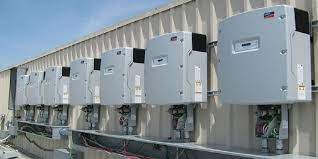
A string inverter is connected with a string of solar panels, which is called the solar array. There are many different ways of connecting a string of solar panels. A typical solar array can consist of around 15 solar panels of each 250Wp.Each solar panel is connected in series to the string inverters. The inverter combines all the direct current received from each individual solar panel and, at once, converts it into alternating current. The number of solar panels that can be connected to a string inverter depends upon the input voltage rating of the inverter.
String inverters are the most common type of solar inverter and have been around for decades. The main reason for their success is their robustness and durability, and a few years ago they weren’t any alternatives on the market
Ease of Maintenance and Troubleshooting
Most of the string inverters are installed in a common room, mounted on the wall. This facilitates the ease of maintenance, as one does not have to go back and forth to the field for troubleshooting. This is a serious benefit in places with extremely cold or hot climates.
Trusted Technology
As mentioned earlier, string inverters have been around for decades. As a result of this, most string inverters are reliable and it’s a technology well understood by electricians.
Lower costs
When it comes to the costs, string inverters are currently cheaper than micro inverters. You only need one string inverter per installation, while for micro inverters, one would need one inverter per panel.
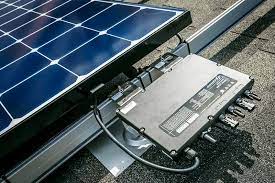
A micro-inverter is device that connects to a single solar panel, converting DC (direct current) from the panel into AC (alternating current), which can power household appliances or be sent into the grid for energy credits. Unlike string inverters, micro-inverters control the output of a single panel.
Weakest link effect. You are probably familiar with the old-school Christmas lights that are connected in series where if one bulb fails, it takes the entire string with it. Solar panels attached to a central inverter also have the same vulnerability: one defective panel can stop the entire string from working which will result in a significant or complete loss of electrical supply. This also applies to shading where one or two shaded panels can cause the system to produce at a low level since the central inverter optimizes the output based on the weakest link in the chain. Worse, you may never realize that the system is performing at suboptimal levels since a minor output reduction in the range of 10-20% may be the result of weather conditions, or a defective solar panel. Even if a problem is suspected, every solar panel will need to be tested by a qualified technician to find the problem. On the other hand, with micro-inverters, if a solar panel or the attached micro-inverter fails, this will only have a minor impact on your overall system, as the dependence on the weakest link is eliminated.
Better optimization. A micro-inverter enables each solar panel to perform at its maximum potential depending on weather conditions, shading and other external factors. As a result, one solar panel cannot drag down the entire solar array’s performance. A central inverter treats the whole group of solar panels as one giant panel with the electrical properties of the worst performing unit. The performance of this weakest link can be compromised due to a technical defect, or an external factor (such as dirt build-up, shading during a particular time of day or a change in orientation). Moreover, in a centralized design, all panels are typically oriented in the same way, but in cases where this is not feasible (for example on a roof with a complex geometric shape), uniform orientation may not result in the maximum output from all of the panels.
Getting slightly more technical, the type of optimization that inverters perform is called maximum power point tracking (MPPT). Just to avoid any confusion, MPPT is electronic “tracking” which has nothing to do with tracking devices that physically move solar panels to keep them perpendicular to the sun. At any given time, the output of a solar panel is determined by the relationship between the level of solar radiation, ambient temperature and the total resistance. MPPT samples the electrical output of the panels and constantly determines the optimal resistance (load) to maximize the amount of total power. Since each solar panel may have a different amount of solar radiation falling on it at any given moment, the ideal way to perform MPPT is to change the voltage requirement for each panel, which is exactly what micro-inverters can do.
Longer warranty period. A central inverter is exposed to high power and heat loads and, not surprisingly, during the average lifetime of your solar panels (20-25 years), you will probably need to replace your original inverter with a new unit at some point. This fact is fully reflected in the warranty periods offered by central inverter manufacturers: a 5-10 year warranty period is the norm, with an option to buy an extended warranty. Micro-inverters, on the other hand, generally come with a 15-25 year limited warranty, better matching the lifetime expectancy of your panels.
Increased flexibility. Central inverters have a limited range of sizes and if you are in the market for only a few solar panels, you may end up with one that’s much bigger than necessary. Most central inverter manufacturers offer inverters in the 3-6 kilowatts range for residential systems. Conversely, if you would like a system that has a higher capacity, you may need to purchase multiple central inverters to do the job. Micro-inverters do not limit you in this way, as you buy one inverter for each panel you own. As an additional advantage, you can also expand your system over time, by adding more panel and micro-inverter combinations, which may not be an option if your central inverter is tapped-out.
Improved safety. The voltage of the wires linking a central inverter can be very high since the solar panels are connected in series before reaching the central inverter. Sometimes, the voltage can reach as high as 600 volts. Micro-inverters usually operate at 240 volts which is much lower and safer.
Out-of-sight and out-of-hearing. Central inverters require an active cooling system such as noisy fans to cool down the high heat load. Most home owners prefer the inverters to be installed where they are not easily visible, such as the garage, utility room, or loft. However, if these spaces are dusty, hot and have poor ventilation, the lifetime of the inverter can be shortened. In contrast, in addition to being less noisy themselves, micro-inverters take up very little room and are installed right under the solar panels, further from your living area.
Panel-level monitoring. Many micro-inverters come with a standard monitoring service that can show you how much power is being produced at any given time at the panel level. This level of detail can give you a good sense of how your system is performing .
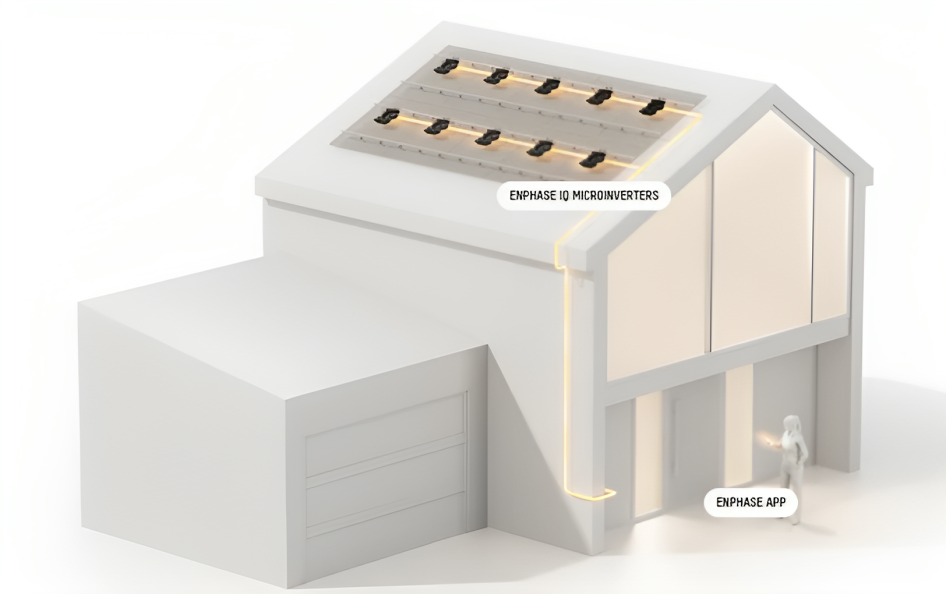
We, Indsol Technologies are partnering with Enphase. Enphase Energy System seamlessly integrates solar technology with cutting-edge software, empowering you to generate and harness your personalized energy using a convenient mobile app. Take control of your energy consumption with just a mobile phone. Control your Enphase system from virtually anywhere with the most powerful mobile app ever created for solar. See exactly where power is flowing through your home in real time. Monitor how much energy you’ve made and used so far this year. In many communities, you can also see how much extra solar power produced during the day is sold back to your utility provider for cash or credit on your electric bill.